Research Overview – Harnessing Photoexcitations on the Nanoscale
The Olshansky Lab is interested in harnessing the power of photons to drive novel and technologically useful processes at the nanoscale. The group is focused on nanomaterials since they offer a platform that can utilize the strengths of both bulk and molecular materials. Notably, nanomaterials can be synthesized at scale, offer tunable and functional interfaces to couple to molecules, and interact with photons and electron spins in unique and useful ways. We believe these materials are particularly well-suited to applications that harness photons to either drive chemical reactions or prepare well-defined spin states. Research in the group is therefore primarily motivated by two application areas: photocatalysis and quantum information science.
The specific nanomaterials of current and near-term interest in the Olshansky lab are colloidal semiconductor nanoparticles, commonly referred to as quantum dots (QDs). Over the last few years, the group has built specific expertise in the photophysics of QD – molecule conjugates and has used these conjugates to enhance understanding in photocatalytic systems and as hosts for novel photogenerated spin configurations. Therefore, research projects can be roughly divided into three categories: foundational research on photophysics in QD – molecule conjugates, photocatalysis, or quantum information science.

Photophysics of quantum dot – molecule conjugates
We seek to expand fundamental mechanistic understanding of photoexcited charge and energy transfer processes in quantum dots. We are especially interested in experimental model systems composed of quantum dots covalently linked to molecular charge acceptors. One way to glean mechanistic information from charge transfer processes is to alter the free energies of either the charge donor or acceptor, and see how this affects charge transfer rates. In our quantum dot – molecular systems, we can tune the energy of the donor (quantum dot) by changing the size, composition, or surface passivation, and we can tune the energy of the acceptor (molecule) with synthetic attachment of electron donating and withdrawing functional groups. We also aim to explore the effect of solvent, temperature, physical distance, and a variety of other parameters in understanding charge transfer.
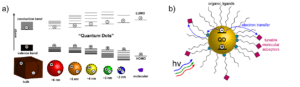
We plan to apply to results of this work to designing QD-molecular systems that can be used in biologically relevant contexts such as dynamic fluorescent sensors. Furthermore, we hope to extend our work to artificial photosynthesis applications by designing systems that can perform photocatalytic and photoelectrochemical carbon dioxide reduction.
Photogenerated spin qubits in nanoscale systems
Photoexcitation of an electron is followed closely in time by charge separation. The resultant charge separated state will consist of a radical cation and a radical anion until the charges recombine or cause a chemical reaction. However, while the charge separated state exists, it possesses unique properties. Specifically, the two unpaired electron spins associated with the two radicals (anion and cation) will be correlated and in a well-defined quantum state. These photogenerated charge states have been termed spin-correlated radical pairs or spin qubit pairs since they have the potential to find applications in quantum information technologies. We hope to use electron paramagnetic resonance techniques to detect these spin qubit pairs in the nanoscale systems described above.
What does research look like?

Researchers in the Olshansky Lab, including undergraduates, are expected to build expertise in their research area such that they can eventually be independent experimentalists. Projects typically involve a research cycle including synthesis, characterization, and computational modelling, and students gain expertise in all three areas. All members are also expected to work collaboratively and highly encouraged to bring their own ideas to research meetings. Other key expectations for students in the lab include a safety-first attitude, diligent notetaking, and regular check-ins with their mentors.
Background information
Photophysical processes in quantum dots
What are photogenerated spin qubits?
Instrumentation
Fluorescence lifetime spectrometer
Time-correlated single photon counting lifetime spectrometer with laser diode excitation at specific wavelengths.
Steady state fluorimeter
Quantamaster 8075 with double excitation monochromators, an integrating sphere, and time-resolved phosphorescence capabilities.
Glovebox
A standard four arm glovebox for air-free manipulation and storage.
Gas Chromatograph
SRI Multiple Gas Analyzer for detecting and quantifying gaseous photocatalysis products such as carbon monoxide and hydrogen.
You must be logged in to post a comment.